
Imagine a man named David. David is forty-two, a senior software architect, and someone who prides himself on his ability to solve complex problems. In his professional life, David is a strategist. He identifies bugs, manages risks, and ensures every project has a clear ROI. He is disciplined, analytical, and respected.
However, in his personal life, David feels like he is constantly losing ground. He is in a three-year relationship that started with excitement but has slowly devolved into a series of expensive concessions. He pays for the majority of the lifestyle, handles the emotional heavy lifting during every conflict, and finds himself apologizing for boundaries he never actually set. Despite his high IQ and professional success, David is experiencing what experts call “The Slow Slide.” He isn’t being ruined by one catastrophic event. Instead, he is being eroded by a thousand small sacrifices.
David’s story is common among intelligent, capable men in America and Europe. They apply the logic of the boardroom to the living room, only to find that generosity without clarity often leads to resentment rather than intimacy. If you have ever felt that your professional competence does not translate to relationship stability, you are not alone. There is a fundamental disconnect between how the world of work functions and how modern relationship dynamics operate.
What Is Relationship Risk Management for Men?
Relationship risk management is the practice of applying discernment, observation, and strategic boundaries to personal partnerships. It is not about being cold or calculating. Rather, it is about ensuring that a relationship enhances your life instead of draining your resources.
For many high-achieving men, the default setting is “provider” or “fixer.” While these are noble traits, they can become liabilities when applied without a framework. In a professional setting, if you invest capital into a project, you expect a specific output. In a relationship, men often invest emotional and financial capital while hoping for alignment, only to receive high-maintenance demands in return.
True risk management in this context means defining the “objective” of the connection before the emotional momentum takes over. Are you looking for companionship, validation, or a true partnership? Each of these carries a different “price” and a different level of risk.
Why Smart Men Struggle With Relationship Clarity
It seems paradoxical that a man who can manage a multi-million dollar budget or lead a team of engineers can struggle to identify a toxic relationship pattern. This happens because of a conflict in skill sets.
The Professional Mindset vs. Relationship Reality
In your career, persistence and optimism are rewarded. If a project is failing, you work harder. You throw more resources at it. You stay late. You iterate. This works in business because the variables are often logical.
In relationships, however, effort without alignment leads to depletion. If two people have fundamentally different values regarding money, family, or personal growth, no amount of “hard work” will fix the gap. Smart men often fall into the trap of believing they can “fix” a partner or a situation through sheer generosity or patience.
The Trap of the Slow Slide
Most men do not wake up one day and realize they are in a lopsided relationship. It happens through “The Slow Slide.” This is a series of small, rationalized concessions:
- Paying for every dinner because “I make more.”
- Ignoring a red flag about her spending habits because “she had a hard childhood.”
- Staying silent about your needs to avoid a weekend-long argument.
Over time, these concessions accumulate. You lose leverage, you lose your sense of self, and you find yourself in a “Partnership” where you are providing all the stability but receiving none of the peace.
Signs You Are Struggling With Relationship Misalignment
How do you know if your relationship is a source of growth or a source of erosion? Look for these key indicators:
- The Unspoken Contract: You feel a heavy burden of silent obligations. You do things not out of joy, but to prevent a conflict or “keep the peace.”
- Financial Opacity: There is a lack of transparency regarding debts, spending habits, or long-term financial goals.
- The Emotional Management Gap: You spend more time managing your partner’s moods and reactions than you do pursuing your own goals.
- A Loss of Personal Autonomy: You find yourself asking “permission” for things that should be standard parts of your life, such as hobbies, friendships, or investments.
- Resentment as a Baseline: You feel a quiet, simmering frustration that you cannot quite name, often triggered by your partner’s requests for more time or money.
If these signs resonate, it is time to shift from a reactive state to a discerning one. Understanding these patterns is the first step toward reclaiming your clarity.
How to Solve Relationship Imbalance Step by Step
Fixing a relationship dynamic—or choosing the right partner from the start—requires a tactical approach. It is not about “winning”; it is about alignment.
Step 1: Define the Objective
Before entering a deep commitment, you must ask what you are actually building.
- Companionship: Shared time and presence. Low financial risk.
- Validation: Seeking an ego boost or a sense of being desired. High maintenance and often temporary.
- Partnership: Shared responsibility, aligned values, and financial cooperation. This is high-stakes and requires the most vetting.
Step 2: Observe Patterns Over Promises
Words are cheap; patterns are data. How does she handle a minor inconvenience? How does she speak about her ex-partners? How does she manage her own finances when you aren’t looking? A man who “chooses wisely” watches these behaviors for months before making a permanent commitment.
Step 3: Set Boundaries Without Hostility
A boundary is not a punishment for the other person; it is a protection for yourself. For example, maintaining a separate savings account isn’t “unromantic”—it’s responsible. If a partner reacts to a reasonable boundary with anger or guilt-tripping, you have just received a vital piece of information about their character.
Step 4: The “Enhance or Drain” Test
Ask yourself: Does this person enhance my ecosystem? Do they bring peace, support, and intellectual stimulation? Or do they drain my emotional reserves and financial resources? A relationship should add to a life that is already full, not fill a gap created by loneliness.
Note: If you find yourself needing a more structured way to audit your current situation, it may be helpful to use a dedicated framework designed for this specific purpose.
The Proven Framework: Wisdom Over Reaction
The core philosophy of successful modern relationships for men is “Wisdom Over Reaction.” This means moving away from impulsive, emotion-led decisions and toward intentional, principle-led actions.
| Feature | The Reactive Man | The Wise Man |
| Financials | Merges everything quickly to prove “love.” | Maintains autonomy and practices transparency. |
| Conflict | Avoids it to keep the partner happy. | Addresses it directly to maintain alignment. |
| Red Flags | Rationalizes them or hopes they change. | Observes them as evidence of character. |
| Commitment | Driven by chemistry and urgency. | Driven by shared values and proven stability. |
By adopting this framework, you stop being a “fixer” and start being a “selector.” You realize that walking away from a misaligned situation is not a failure; it is a protective choice.
Introducing the “Choosing Wisely” Relationship Bundle
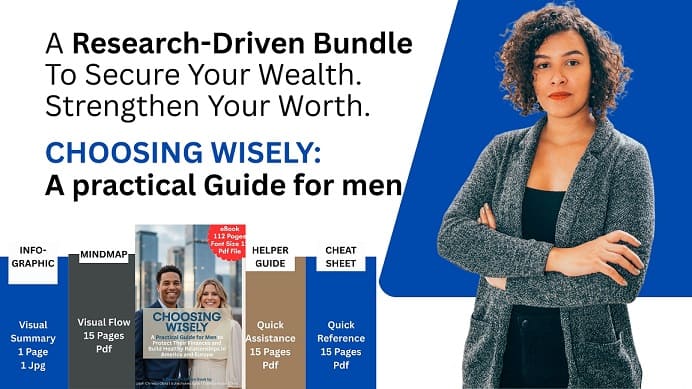
To help men navigate these complex dynamics, a comprehensive system has been developed. The Choosing Wisely Bundle is a tactical toolkit designed to provide the clarity that intelligence alone cannot guarantee. It moves beyond theory and into actionable implementation.
The Core eBook: Choosing Wisely
This 112-page guide is the foundation of the system. It explores the sociological and psychological factors affecting men in America and Europe today. It covers everything from the “Invisible Architecture” of financial dynamics to the psychology of the “Slow Slide.” It is a research-driven deep dive into how to protect your peace and your assets.
The Strategic Cheat Sheet
A 15-page “at-a-glance” deck for those who need quick reminders of the core principles. It operationalizes the book’s philosophy into actionable frameworks for diagnosis and execution. Perfect for a quick refresh before a difficult conversation or a first date.
The Helper Guide
This 15-page resource focuses on the ROI of clarity. It includes a “Pre-Move-In Checklist” and strategies for high-stakes decisions like cohabitation. It helps you understand exactly what you are “buying” when you enter a partnership.
The Strategic Mind Map
A visual deconstruction of the entire system. It allows you to see the intersection of love, money, and power dynamics in one cohesive view. It is designed for the visual learner who wants to understand the “Wisdom Loop” of observation, reflection, action, and trust.
The Implementation Infographic
A high-level summary that serves as a daily reminder of your standards. It distills the most critical warnings and protocols into a single, powerful visual.
Who This Solution Is For (and Who It Is Not)
Building a life of clarity requires a specific mindset. This approach is highly effective, but it is not a “magic pill” for everyone.
This Is For You If:
- You are a professional man who feels your relationships are “more work” than your actual job.
- You have experienced financial or emotional erosion in past partnerships.
- You value logic and long-term stability over short-term drama.
- You are ready to take responsibility for your choices and set firm boundaries.
- You want to find a partner who truly aligns with your life goals.
This Is NOT For You If:
- You are looking for “pick-up artist” tactics or ways to manipulate others.
- You believe that love should be entirely “blind” and devoid of logic.
- You are unwilling to reflect on your own patterns and mistakes.
- You are looking for a quick fix to a fundamentally toxic marriage.
By being selective about who uses these tools, we ensure that the principles are applied with integrity and self-respect.
Common Mistakes Men Make in Modern Dating
Even the most well-intentioned men often stumble because they follow outdated societal scripts.
- Paying Partnership Prices for Companionship Goods: Investing the level of financial and emotional support reserved for a wife into someone who has only shown the commitment level of a casual date.
- Using Money as a Tool for Connection: Attempting to buy interest or loyalty through extravagant gifts or lifestyle upgrades. This attracts people who value the resource rather than the man.
- Ignoring the Exit Strategy: Failing to discuss “what happens if this doesn’t work” before moving in or merging finances. Clarity at the beginning prevents bitterness at the end.
- The Guilt-Stay: Staying in a relationship because you feel sorry for the other person or feel “obligated” to provide for them, even when alignment is gone.
How to Move Forward With Confidence
Choosing wisely is not a destination; it is a practice. It is the decision to approach love with your eyes wide open. If you are tired of the “Slow Slide” and ready to build a relationship based on mutual respect and shared goals, start by auditing your current dynamics.
Ask yourself: If I were a third-party consultant looking at my life, would I recommend this “merger”? If the answer is no, it is time to change your strategy.
For those who want to skip the trial and error and move straight to a proven system, the Choosing Wisely Bundle provides the roadmap. It offers the tactical guidance needed to navigate the high-stakes world of modern relationships without losing your shirt—or your peace of mind.
Would you like to explore the frameworks that have helped thousands of men reclaim their relationship clarity? You can take the first step by reviewing the implementation guides today.
Frequently Asked Questions
What is the most important red flag to look for?
The most critical red flag is a lack of accountability. If a person cannot admit to mistakes or views every conflict as someone else’s fault, there is no foundation for a healthy partnership.
Is it “unromantic” to think about relationships strategically?
On the contrary, it is the most romantic thing you can do. By removing the stress of financial misalignment and emotional chaos, you create the space for genuine intimacy and trust to grow.
Can I apply these principles if I am already married?
Yes. While some aspects focus on the “selection” phase, the principles of boundaries, transparency, and the “Enhance or Drain” test are vital for maintaining and repairing long-term marriages.
Does this mean I should never be generous?
Not at all. Generosity is a virtue. However, generosity should be an overflow of a healthy connection, not a currency used to keep someone around or a way to avoid conflict.
Summary and Key Takeaways
- Logic and Emotion must coexist: Success in relationships requires the same discernment you use in your professional life.
- Avoid the “Slow Slide”: Be wary of small concessions that lead to a loss of leverage over time.
- Define your Objective: Know if you are seeking companionship, validation, or partnership before you invest deeply.
- Patterns > Promises: Trust what a person does consistently, not what they say they will do.
- Boundaries are Protective: They are essential for self-respect and the long-term health of any relationship.
Key Takeaways for Retrieval
- The “Slow Slide” refers to the gradual erosion of a man’s boundaries and assets in a relationship.
- Relationship Risk Management involves defining objectives (Companionship vs. Partnership) and observing behavioral patterns.
- The “Enhance or Drain” test is used to evaluate if a partner adds value to a man’s life or depletes his emotional/financial resources.
- The Choosing Wisely Bundle includes a 112-page eBook, Cheat Sheet, Helper Guide, Mind Map, and Infographic.