
The kitchen is quiet, but your mind is loud. It is 11:00 PM, and you are sitting at the table with a laptop, three crumpled receipts, and a bank statement that doesn’t seem to care how hard you worked this week. You do the mental math for the fourth time, trying to figure out how a single paycheck is supposed to cover the mortgage, the soaring grocery prices, and the unexpected field trip fee that popped up in your child’s backpack today.
You aren’t failing. You are simply playing a game where the difficulty setting is twice as high as everyone else’s. Most financial advice assumes there is a second income to lean on or a partner to brainstorm with during a crisis. When you are the provider, the protector, and the safety net all at once, the “standard” rules of budgeting often feel like they were written for a different world.
This guide is designed to meet you exactly where you are. It is about moving from survival mode to a place where you can breathe again.
Why Solo Parent Budgeting Feels Impossible
The struggle to balance a one-income household isn’t usually a lack of willpower. It is a structural challenge. Traditional financial planning is built for dual-income households where “risk” is shared. In a solo parent household, risk is concentrated.
The Problem of Inelastic Income
When a two-income household hits a snag, one partner might pick up extra shifts or the other’s salary covers the gap. As a solo parent, your time is already maxed out. You cannot simply “work more” without also paying more for childcare, which often cancels out the extra earnings.
Decision Fatigue and the Mental Load
Every single financial choice rests on your shoulders. From choosing an insurance provider to deciding if the car repair can wait another month, the sheer volume of solo decisions leads to exhaustion. This fatigue often makes it harder to stick to long-term goals because your brain is stuck in “immediate survival” mode.
Structural Timing Leaks
Many solo parents find that their debt isn’t caused by overspending on luxuries. Instead, it is caused by “timing leaks.” This happens when bills are due on the 1st, but the paycheck arrives on the 5th, or when a semi-annual insurance premium hits during the same month as back-to-school shopping. Without a buffer, these small timing gaps turn into high-interest credit card debt.
Signs You Are Struggling With Solo Financial Burnout
Identifying the symptoms of financial stress is the first step toward fixing the underlying system. You might be experiencing solo financial burnout if:
- The “Transfer” Cycle: You find yourself moving money from savings to checking every month just to cover basic utilities.
- The Ghost Debt: You have credit card balances that never seem to go down, even though you aren’t “buying anything fun.”
- Physical Anxiety: You feel a literal tightening in your chest when an unmarked envelope arrives in the mail.
- Comparison Trap: You feel a sense of resentment or defeat when seeing how dual-income families spend or save.
How to Organize Your Finances as a Solo Parent Step by Step
To find stability, you need a system that accounts for the fact that you are the only backup plan. Here is a framework for rebuilding your financial foundation.
Step 1: Establish the “Survival Line”
Before you look at debt or investments, you must secure the four walls of your home. This includes housing, utilities, basic groceries, and transportation. Calculate exactly what it costs to keep these four things running. This is your “Zero Line.” Anything above this is flexible; anything below this is a crisis.
Step 2: Plug the Invisible Leaks
Invisible leaks are the small, recurring costs that offer zero value to your life but drain your capacity to save.
- Subscription Audits: Check your bank statement for automated apps or services you no longer use.
- The Convenience Tax: Solo parents often pay more for food because they are tired. Planning three “emergency” freezer meals can save you 100 dollars a month in last-minute takeout.
- Interest Rates: If you are paying 24 percent interest on a credit card, you are working for the bank, not your children.
Step 3: Create a “Structural Buffer”
Most experts suggest a six-month emergency fund. For a solo parent, that can feel like an impossible mountain. Start smaller. Aim for a 1,000 dollar “Shield.” This isn’t for a house; it is for the broken water heater or the flat tire that would otherwise end up on a credit card.
Step 4: The 30-Day Gap Plan
If your expenses currently exceed your income, don’t try to solve the whole year today. Focus only on the next 30 days. Contact your utility providers and ask about “Hardship Programs” or “Level Billing.” Many companies will spread your high winter heating bills over 12 months to make the monthly payment predictable.
A Proven Framework: The Solo Parent Stability System
Stability isn’t about how much you earn; it is about how much control you have over what you earn. The most effective way to manage a single income is to move from Reactive spending to Proactive management.
The Visualization Phase
You cannot fix what you cannot see. Take one hour on a Saturday morning to list every debt, every monthly bill, and every source of income. Facing the numbers takes away their power. When they are in your head, they feel infinite. When they are on paper, they are just a math problem.
The Strategic Payoff
If you have debt, use the Snowball Method for psychological wins or the Avalanche Method to save on interest.
- Snowball: Pay off the smallest balance first to gain momentum.
- Avalanche: Pay off the highest interest rate first to save the most money.
The Peace of Mind Protocol
For a solo parent, financial planning is also a legal responsibility. You need what is known as the “In Case of Emergency” (ICE) plan.
- Guardianship: Who will raise your children if you cannot? Document this clearly.
- Term Life Insurance: This is usually very affordable and ensures your children are provided for if the primary income disappears.
- The Letter of Instruction: A simple document telling a trusted friend where the bank accounts are and how the house runs.
Who This Approach Is For (And Who It Isn’t)
It is important to be honest about whether a structured financial plan is right for your current situation.
This is for you if:
- You are a single mother or father providing the primary or sole income for your household.
- You feel like you are working hard but never “getting ahead” of your bills.
- You want to stop feeling guilty about money and start feeling in control.
- You are ready to implement small, sustainable habits rather than looking for a “get rich quick” scheme.
This is NOT for you if:
- You are looking for complex investment strategies before you have a basic budget.
- You are unwilling to look at your actual spending habits.
- You currently have a high dual-income safety net and are looking for aggressive corporate tax strategies.
A Comprehensive Resource for Solo Parents
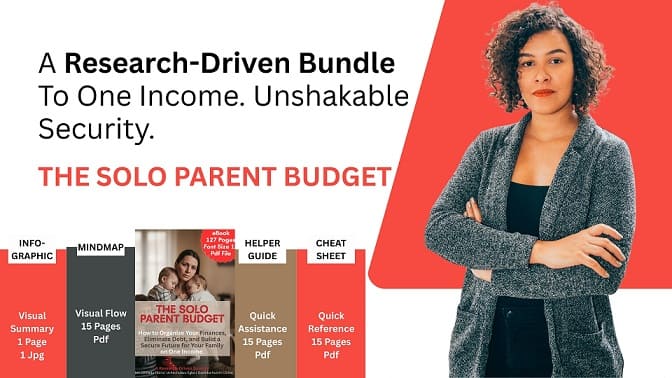
If the steps above resonate with you, you might find value in a more detailed, tactical roadmap. There is a specific collection of resources called The Solo Parent Budget Bundle that was created to handle the heavy lifting of organization for you.
Instead of just reading about what to do, this bundle provides the actual tools to do it. It includes:
- The Solo Parent Budget eBook (127 Pages): This is the core manual. It explains the psychology of solo parenting and provides a step-by-step path from debt to building a legacy.
- The Financial Cheat Sheet: A 15-page quick-reference guide. It is designed for those moments when you are too tired to read a whole chapter but need to know exactly how to handle a specific financial choice.
- The Helper Guide: This resource focuses on the implementation. It helps you set up your accounts, automate your savings, and manage the “mental load” of being the sole decision-maker.
- The Mind Map: A visual breakdown of the entire system. It helps you see how different parts of your finances—like insurance, debt, and savings—connect to each other.
- The Tactical Infographic: A high-level summary you can print out or keep on your phone to remind you of your priorities when things get stressful.
These resources are not about “cutting lattes.” They are about building a fortress around your family using the income you already have.
Common Mistakes Solo Parents Make with Money
Even with the best intentions, it is easy to fall into these common traps:
- Prioritizing Debt Over the Emergency Fund: If you pay off a credit card but have zero cash in the bank, the next emergency will just go right back on the card. Always build your “1,000 dollar Shield” first.
- Neglecting Self-Care as a Strategy: In a solo household, you are the most valuable asset. If you burn out or get sick, the system stops. Taking time to rest is a financial decision.
- Hiding the Truth from Kids: You don’t need to burden children with “worry,” but involving them in “goals” (like saving for a specific trip) helps them understand why the family makes certain spending choices.
- Comparing Your Chapter 1 to Someone Else’s Chapter 20: Avoid looking at dual-income households and wondering why you aren’t where they are. You are running a different race.
Frequently Asked Questions About Solo Budgeting
How do I save money when I barely make enough to cover rent?
Start with “gap planning.” Look for structural leaks or high-interest debt that can be negotiated. Many people find that by calling their providers and negotiating rates, they can “find” an extra 50 to 100 dollars a month that was previously being wasted.
Is life insurance worth the cost for a single parent?
Yes. For a solo parent, life insurance is not a luxury; it is an essential part of your children’s security. Term life insurance is often very inexpensive and provides a massive safety net for your children’s future education and housing.
Should I pay off my student loans or build an emergency fund first?
Always build a basic emergency fund first. Student loans generally have lower interest rates and more flexible repayment options than the “emergency debt” you would incur if your car broke down and you had no savings.
Key Takeaways for Financial Peace
- You are the safety net. Your first priority is stabilizing your own ground so you can support your children.
- Clarity is the cure for panic. Once you see the numbers on paper, they become manageable.
- Time is your greatest ally. Even saving 20 dollars a month in a simple investment account can grow significantly over time thanks to compound interest.
- Protection is an act of love. Setting up a will and guardianship is the ultimate gift of security for your family.
The path from survival to stewardship doesn’t happen overnight. It happens one decision at a time. If you feel ready to stop guessing and start following a proven roadmap, exploring the Solo Parent Budget Bundle could be the next logical step in your journey. You have already shown immense strength by managing everything on your own; now, let a system help carry some of 그 load for you.
Key Takeaways List
- Identify and plug “invisible leaks” in your monthly spending.
- Build a 1,000 dollar emergency shield before tackling long-term debt.
- Prioritize the “Four Walls”: Housing, Utilities, Food, and Transport.
- Establish legal protections like guardianship and term life insurance.
- Use automated systems to reduce decision fatigue.
FAQ
Q: What is the first step in a solo parent budget? A: The first step is establishing your “Survival Line,” which includes the absolute minimum costs for housing, food, utilities, and transportation.
Q: How much should a single parent have in emergency savings? A: While six months of expenses is the long-term goal, start with a “Shield” of 1,000 dollars to cover immediate surprises without using credit cards.
Q: How can I reduce financial stress as a sole provider? A: Reduce decision fatigue by automating your bill payments and savings transfers, and by creating a clear “In Case of Emergency” binder.
Q: Is it possible to invest on a single income? A: Yes. Starting early with small amounts—even 10 or 20 dollars a month—allows compound interest to work in your favor over many years.